

While the query specifies a digital file (FLAC), the romance of a "Greatest Hits" traditionally lies in the physical artifact—the liner notes, the unreleased photos, the B-sides. A 2024 release would likely exist in two realms: the streaming version (for convenience) and the boutique 24-bit download (for purists). The fact that a fan is searching for the 24-bit FLAC version suggests a rejection of the compressed, ad-riddled streaming experience in favor of owning a permanent, high-quality archive.
If such an album existed in 2024, it would face the unique challenge of Lavigne’s identity. Early in her career, she rejected the "pop" label, famously feuding with Britney Spears and Christina Aguilera. Yet, her greatest hits are undeniably pop songs built on punk chords. A 2024 retrospective would have to reconcile this duality. Avril Lavigne - Greatest Hits -2024- -FLAC- -24...
While “Avril Lavigne - Greatest Hits -2024- -FLAC- -24bit” is currently a hypothetical file name, it represents a logical and desirable endpoint for the artist’s first two decades. It acknowledges the audiophile’s demand for sonic fidelity and the fan’s desire for a curated journey through hits like I’m with You , Keep Holding On , and Head Above Water . While the query specifies a digital file (FLAC),
Until an official announcement comes, these search queries serve as a petition from the public. They tell the record label that fans are ready to pay a premium for Lavigne’s legacy, provided it is delivered in the highest resolution possible. For now, the "Greatest Hits of 2024" remains a ghost in the machine—a perfect album that exists only in the hopes of the fans who type its name into search bars. If such an album existed in 2024, it
Furthermore, a 2024 release would arrive in the wake of the "pop-punk revival" spearheaded by artists like Olivia Rodrigo, Machine Gun Kelly, and Willow Smith—all of whom cite Lavigne as a primary influence. A greatest hits album at this moment would not feel like a farewell; it would feel like a victory lap and a passing of the torch. Tracks like Bite Me (2021) prove she can still write hits that rival her early work, meaning a 2024 compilation would be a living document, not a mausoleum.
The specific demand for FLAC - 24bit in the query is crucial. Unlike standard CD quality (16-bit/44.1kHz), 24-bit audio offers a higher dynamic range. For a producer like Lavigne, who layers distorted guitars, punchy drums, and breathy vocals, 24-bit FLAC preserves the transients of the drum hits and the texture of the electric guitars without the compression artifacts found in MP3s.
As of my last knowledge update in October 2023, Avril Lavigne had not released a formal “Greatest Hits” package for 2024. However, the search query itself is a fascinating artifact of modern music consumption. It reflects the demand for high-fidelity audio (24-bit FLAC) and the anticipation of a career retrospective for one of pop-punk’s most enduring icons. This essay will analyze why such an album is inevitable, the significance of the 24-bit FLAC format, and the cultural weight of Lavigne’s two-decade career.


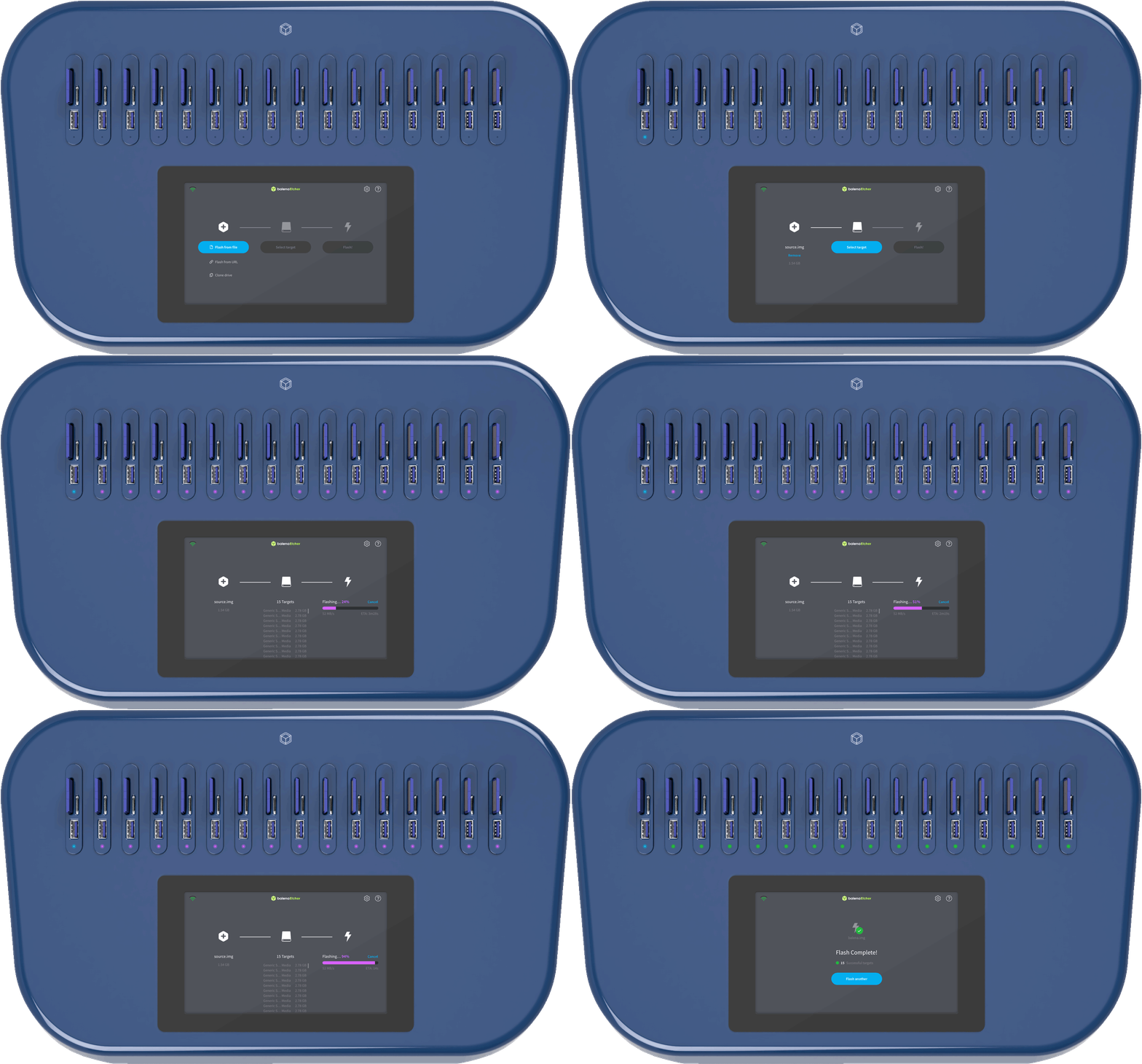
Every EtcherPro can flash up to 16 drives at a time if you are flashing from an online source. If you are flashing from a physical drive, you would be flashing up to 15 drives at a time, as the first slot would serve as the source. In the daisy-chaining scenario, you would only require one slot to serve as a source to flash the entire stack, when flashing from a physical drive.
EtcherPro offers USB (type A), SD and microSD interfaces by default, so you can flash up to 16 different drives / devices simultaneously. For instance, you can flash a balenaFin, a USB drive, an SD card and a microSD at the same time, as long as there is only one target per slot, and the source being flashed is the same for all target types.
EtcherPro supports USB (type A), SD and microSD interfaces, and can also flash single-board computers that are capable of being flashed via USB, as long as they are supported by Etcher. You can flash compute modules through carrier boards, for instance, flashing a Raspberry Pi CM3 through a balenaFin.
EtcherPro runs our open-source data-flashing software, Etcher, which can flash any kind of data. If you want to make sure that Etcher is capable of flashing your drive / device, you can download the latest version of Etcher and test it on your system to ensure compatibility.
When writing 16 drives simultaneously, EtcherPro can write up to 52 MB/s per drive, while when writing just 1 drive, EtcherPro can reach up to 200MB/s, so long as the drive / device can support those flashing speeds.
Etcher has a feature known as ‘trimming’ which can potentially accelerate the flashing of certain images by avoiding writing unused parts of ext partitions. As a result, you effectively get a bonus on the flashing speed.
EtcherPro flashes all target drives simultaneously, as such, the speed is determined by the drive that writes slowest. If you flash 1 drive that writes slowly, and 15 fast ones, the slow drive will determine the overall write speed. To account for this, make sure that all the drives, including the source drive (if any), can write at least as fast as EtcherPro flashes (52MB/s for 16 drives). Oftentimes, the advertised speed for a drive is the reading speed, rather than the writing speed (which is much slower). If you are sure your setup is up to spec and you still have issues please contact us.


.webp)